Newly Leaked Pentagon Video Shows Hellfire Missile Bouncing off UAP/UFO
 11 min read
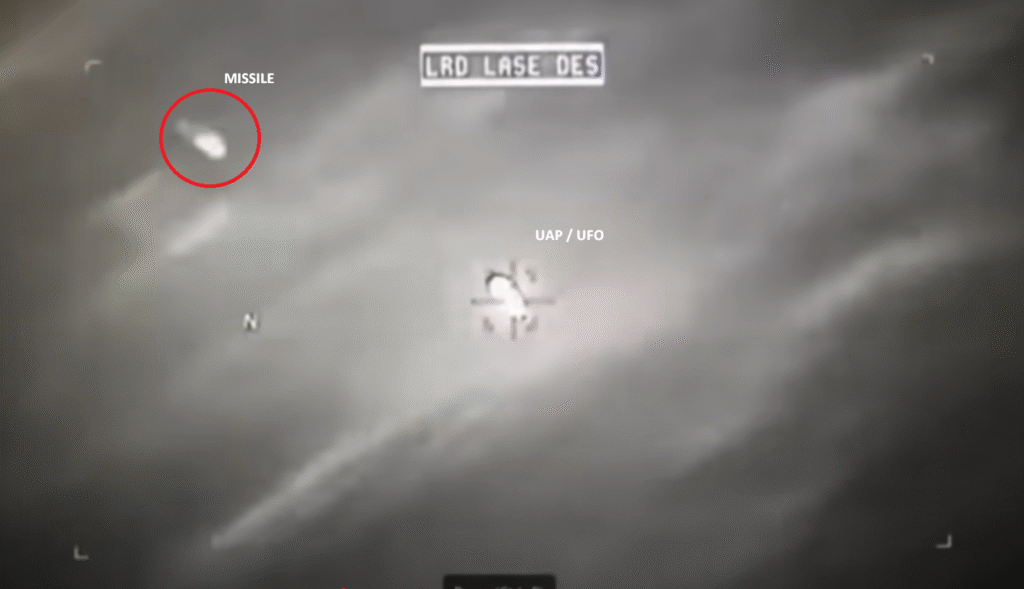
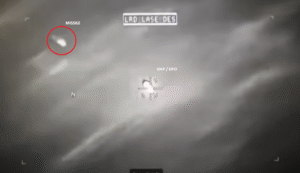
Imagine the most powerful projectile in the modern arsenal. A Hellfire missile, designed by Lockheed Martin with a multipurpose warhead to destroy a broad range of targets. Now, picture it striking something in the sky—something that doesn’t just survive, but seems to ignore the impact entirely. This isn’t a scene from science fiction; it’s the stunning reality presented in a newly leaked Pentagon video that’s forcing us to ask a fundamental question: what on Earth—or beyond it—could possibly do that? The footage, revealed by Representative Eric Burlison from a whistleblower, shows the precision-guided missile making contact with an Unidentified Aerial Phenomena (UAP). Instead of a fiery explosion, the object continues its flight, utterly unscathed, as the missile’s debris tumbles away. How do we even begin to explain an event that so blatantly defies our understanding of physics and material science?
The context of the encounter is just as critical as the content. This wasn’t an isolated anomaly in a vacuum; it occurred in a active military theater off the coast of Yemen in late October 2024. At the time, the US military was conducting regular airstrikes against Houthi targets that threatened naval and commercial ships. The video itself, captured by an MQ-9 Reaper drone’s infrared targeting system, is dated October 30th. This places the event squarely within a period of intense regional conflict, raising immediate flags. Was this object a threat? A neutral observer? Or something else entirely? The very setting forces us to consider the high-stakes reality of these encounters; this isn’t just about curiosity, it’s about national security and the safety of our personnel.
The testimony of experts like Lue Elizondo, a former senior Pentagon intelligence official, adds profound weight to the video’s shock value. He stated plainly, “We’ve never seen a Hellfire missile hit a target and bounce.” He elaborated on the missile’s devastating power, noting that when it strikes a solid target, “there’s usually not much left.” His analysis confirms what our eyes see: the missile either deflects or bounces off and keeps flying. This isn’t a minor glitch or a sensor error; it’s a physical impossibility with our current technology. Elizondo’s credentials make his astonishment our own, transforming a strange video into a legitimate scientific and military paradox that demands an explanation.
So, where does this leave us? The immediate, knee-jerk reaction is to reach for the extraordinary. Yet, good science requires we explore all possibilities. Harvard scientist Avi Loeb offers a more terrestrial, though still significant, theory. He posits the object could be a drone launched by Yemen towards Israel, noting Houthi announcements of such attacks around that time. This is a crucial counterpoint. It forces a disciplined approach: could this be advanced human technology rather than something otherworldly? Either scenario carries immense implications. If it’s an adversary’s drone, its resilience represents a terrifying leap in their defensive capabilities that we must understand immediately.
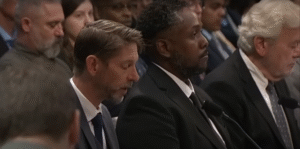
Ultimately, the video’s release during a Congressional hearing on UAP transparency is perhaps more important than the footage itself. It represents a monumental shift. For decades, the official stance has been one of dismissal and secrecy. Now, lawmakers are using their oversight power to pry open the vault. They’re demanding answers not just on this incident, but on a systematic pattern of obfuscation. This push for government transparency isn’t about satisfying fringe curiosity; it’s about compelling the Department of Defense and intelligence agencies to finally share what they know. The very existence of this hearing, fueled by whistleblower courage, signals that the era of denial is over. A new chapter of rigorous, scientific inquiry is beginning, and it’s starting with a missile that refused to do its job.
The Whistleblower’s Gambit: Courage, Secrecy, and The Fight for Truth
The journey of this video from a classified server to a public hearing is a story of immense personal risk and principle. Someone, somewhere inside the vast machinery of US defense, saw this footage and knew the world needed to see it. This whistleblower didn’t act on a whim; they made a conscious decision to bypass a system they believed was failing its duty to the public. They reached out to Representative Eric Burlison, providing a piece of visual evidence so potent it could anchor an entire Congressional hearing. What does it say about our system when truth relies on individuals willing to bet their careers, their clearances, and their livelihoods? Their action is a powerful testament to the belief that some information is too critical to remain hidden.
This act of disclosure highlights a brutal reality for those within the system who encounter the inexplicable: profound stigma. As journalist George Knapp testified, witnesses and whistleblowers who step forward are “routinely insulted, belittled, or worse.” They face not just professional suicide but also personal ridicule. This creates a chilling effect, ensuring that countless other potential revelations remain locked away behind a wall of fear. How many other videos, how many sensor readings, how many pilot testimonies are gathering digital dust because the cost of speaking out is simply too high? The system, by design, protects secrecy at the expense of understanding, leaving our collective knowledge tragically incomplete.
The legal framework meant to protect these individuals, like the Freedom of Information Act (FOIA), is often deliberately circumvented. Knapp pointed to a common tactic: moving sensitive programs and information into the hands of private contractors. This creates a shell game that effectively shields them from public scrutiny and FOIA requests. A contractor isn’t a federal agency; it’s a corporation, and its secrets are its own. This outsourcing of America’s biggest mystery isn’t just about efficiency; it’s a brilliantly designed opacity machine. Congress can grant itself all the clearances it wants, but if the core data resides in a private facility, those clearances are effectively worthless.
This is why the current Congressional push is so revolutionary. Lawmakers aren’t just asking for more videos; they’re demanding a overhaul of the entire process. They’re calling for “standardized checklist and training,” as one witness stated, to ensure the best possible sensor data is captured during encounters. They’re advocating for “reporting without stigma” and “protection without retribution” for service members. This isn’t a partisan issue; it’s a practical one. When a sailor or pilot sees something they can’t identify, their first thought shouldn’t be about career implications. It should be about accurately reporting a potential safety and security threat.
The fight for UAP transparency, therefore, is a fight to restore integrity to the scientific process. It’s about creating channels where data can flow without fear, where observations are documented with precision, and where analysis is conducted in the light of day. The whistleblower who leaked this video didn’t just provide a piece of evidence; they threw a switch, illuminating the deep structural problems that have plagued this subject for over seventy years. Their courage is the catalyst for building a new, more honest system where curiosity is rewarded, not punished, and where the pursuit of knowledge finally triumphs over the culture of secrecy.
Beyond the Video: The Broader Pattern of UAP Encounters
While the Yemen incident is stunningly clear, it’s crucial to understand it isn’t an isolated event. It’s a single, dramatic data point in a vast and growing catalog of mysteries. The All-Domain Anomaly Resolution Office (AARO), the Pentagon’s official body for investigating these phenomena, is presumably sitting on a mountain of similar data. For years, credible witnesses—from seasoned Navy pilots to intelligence officials—have reported objects performing maneuvers that defy known physics. They describe instantaneous acceleration, hypersonic velocities without sonic booms, and trans-medium travel, seamlessly moving between air and water. What patterns emerge when we look at all this together?
The common thread isn’t necessarily little green men; it’s performance. These objects, whatever they are, consistently demonstrate a mastery of physics that lies far beyond our own technological horizon. As the leaked documents obtained by Knapp through FOIA requests revealed, internal government communications admitted these “things are real… they’re evasive, and they outperform any aircraft known to exist.” This isn’t speculation from UFO enthusiasts; it’s a cold, hard assessment from within the military-intelligence apparatus. The objects exhibit capabilities that, if replicated, would revolutionize aerospace engineering and energy production. So, the real question becomes: are we observing a natural phenomenon we don’t understand, or are we seeing technology?
The implications for aviation and maritime safety are immediate and terrifying. Witness Chief Alexandro Wiggins underscored this point, stating that encounters near ships and aircraft are “first and foremost a safety issue.” When an unknown object can zip through controlled airspace with impunity, the risk of a catastrophic mid-air collision is real. Pilots are trained to handle known threats and traffic, not objects that can appear and disappear from radar and visual contact in seconds. This isn’t a theoretical debate; it’s a pressing operational hazard that requires new protocols and serious attention from civilian and military aviation authorities alike.
This persistent pattern also forces a re-evaluation of the extraterrestrial hypothesis. While it’s not the only option, its probability increases with each credible report. The universe is astronomically vast and old. The notion that we are the only intelligent life form seems increasingly naive. Could these UAPs be the product of a non-human intelligence? It’s a possibility that science must now seriously consider without ridicule. The evidence, gathered from radar, infrared sensors, and the eyeballs of trained observers, is pointing toward something truly revolutionary. Dismissing it out of hand is the most unscientific approach we could take.
Therefore, the Yemen video is a key that unlocks a much larger door. It’s tangible, shareable proof of a phenomenon that has been reported for decades. It moves the conversation from whispered stories in hangars to the forefront of public and scientific discourse. It provides a reference point, a case study that can be pored over by physicists, engineers, and metallurgists. Each analysis, each frame-by-frame breakdown, brings us closer to understanding not just this one event, but the entire enigmatic puzzle of which it is a part. We’re no longer just looking at a single mystery; we’re starting to see a pattern that could change everything.
The Hearing and The Horizon: Congress Demands Answers
The September 2024 hearing titled “Restoring Public Trust Through UAP Transparency and Whistleblower Protection” wasn’t just another political event; it was a historical pivot. For the first time, the conversation was framed not around whether these phenomena exist, but around why the public hasn’t been told the truth. The message from lawmakers was unanimous and clear: the federal government has failed. It has withheld information, misled the public, and allowed a culture of fear to silence those who know more. This hearing was about starting to fix that fundamental breach of trust.
The witnesses laid out a tripartite call to action: safety, science, and salvation for truth-tellers. They articulated the immediate safety risks posed by unidentified craft in controlled domains. They argued for a rigorous scientific approach, equipped with proper data collection protocols. And they begged for the salvation of whistleblowers from the professional purgatory they currently face. U.S. Air Force veteran Jeffrey Nuccetelli powerfully stated that “Transparency is the foundation of truth. Without it, witnesses like us are dismissed.” His words cut to the core of the issue—without protection, the truth remains imprisoned.
A major focus was the dysfunctional role of over-classification and the deliberate hiding of information. Representative Tim Burchett and George Knapp discussed how classification protocols are often used not to protect national security, but to conceal embarrassing or paradigm-shattering information. The movement of programs into private hands is the ultimate expression of this—creating a “black world” immune to democratic oversight. Congress is now realizing that its own tools, like the power of the purse and the power to subpoena, may be blunt instruments against a system designed to be impenetrable.
So, what can be done? The hearing’s key takeaways provide a roadmap. Congress must legislate stronger whistleblower protections specifically for those reporting on UAPs. It must mandate that agencies like AARO standardize their data collection and reporting procedures. It must use its oversight powers to “follow the money,” as Knapp suggested, tracing the billions of dollars in black budget spending that may be funding retrieval and reverse-engineering programs about which even the President might be unaware. This is a forensic accounting exercise on a monumental scale.
The hearing’s ultimate value was its normalization of the topic. By bringing it into the sober, official setting of Congress, they drained it of the stigma that has poisoned the well for decades. They reframed UAPs from a tabloid fantasy into a legitimate issue of government transparency, national security, and scientific discovery. This creates a permission structure for academics, journalists, and more officials to engage with the topic seriously. The hearing didn’t provide all the answers, but it finally started asking the right questions in the right room. The door is now open, and it’s going to be very hard to close it again.
From Speculation to Science: The Path Forward for UAP Research
The era of grainy videos and hearsay is ending. We’re now entering the phase of data-driven discovery. The challenge before us is monumental but exhilarating: how do we apply the scientific method to a phenomenon that is seemingly elusive, unpredictable, and technologically superior? The first step is acknowledging the data we already have. The government must declassify and release sensor data—full-spectrum information from radar, infrared, optical, and radio frequency sensors—from incidents like the Yemen encounter. Raw data, not just curated videos, is the lifeblood of scientific analysis.
Simultaneously, we need to deploy new, purpose-built instruments. As astrophysicist Avi Loeb’s Galileo Project proposes, we should aim sophisticated telescopes and sensors at the sky with the explicit goal of detecting and characterizing UAPs. This moves research out of the shadows of government secrecy and into the open, peer-reviewed world of academia. Why are we waiting for military encounters? Let’s actively look with the best tools we have, treating UAPs not as a military secret but as a natural phenomenon we are trying to understand, much like astronomers study gamma-ray bursts or gravitational waves.
The material science angle is equally critical. The Yemen video suggests the object possessed material properties we can scarcely imagine. What material can absorb the kinetic and explosive energy of a Hellfire missile without a scratch? Theorizing is one thing, but we need physical evidence. This puts a huge emphasis on recovery efforts. If objects have crashed or left debris behind, that material must be analyzed by the world’s top labs. Its isotopic ratios, atomic structure, and material properties would tell us unequivocally whether its origin is terrestrial or something else entirely. This is the holy grail of UAP research.
This journey also requires a new language. The term “UFO” is burdened with decades of cultural baggage and ridicule. “UAP—Unidentified Anomalous Phenomena—is a step in the right direction, but we can go further. We need precise terminology to describe the observed capabilities: instantaneous acceleration, hypersonic velocity in atmosphere, trans-medium travel, and low-observability. By describing what these objects do in precise, scientific terms, we divorce the phenomenon from speculation about who’s inside them and focus on understanding the physics behind the performance.
Finally, this must be a global, collaborative effort. The phenomenon isn’t confined to US airspace. Incidents are reported worldwide. A problem of this magnitude, with implications for physics, technology, and perhaps even our understanding of life itself, cannot be solved by one nation acting alone. We need an international consortium, sharing data openly and freely. The quest to understand UAPs is perhaps the greatest scientific mystery we have ever faced. It’s time to stop whispering about it in the corners of the internet and in classified briefings. It’s time to bring it into the light of the world’s laboratories and universities. The truth isn’t just out there; it’s waiting for us to finally get serious about finding it.
The leaked UAP video can be seen here: